


Every CX team has a version of the same conversation waiting for them. Someone senior asks how good the company actually is at customer experience, and the honest answer is a shrug dressed up as a sentence. We have a CX program. We're on a journey. We're further along than we were.
None of that survives a follow-up question. A capability model exists to put a scale behind the shrug, and ours has four pillars, twenty capabilities and a four-level ladder. You can commission the full assessment from us, and many organizations do. But budget arrives late, sponsors need convincing, and the quarter you need an answer is rarely the quarter you have one.
So here is the part worth saying out loud: the model works without the assessment. It runs on a Tuesday afternoon, with a notebook and an honest hour.
Capability is a state you hold, not a score you got
The most expensive misunderstanding about maturity models is that they produce a verdict. A number arrives, it goes on a slide, everyone agrees the company is a 2.4, and nothing else happens for eighteen months.
Capability does not behave that way. You hold it; you do not earn it once. The reorganization that moved service under operations, the analyst who left in March, the platform migration that quietly broke the feedback loop: each of those changes what the company can actually do for a customer, and none of them wait for your assessment cycle. Academic work on customer experience management describes it as a set of firm capabilities for continually renewing the experience, sitting alongside cultural mindsets and strategic direction, not underneath them.[1] Renewal is the operative word. A capability you are not maintaining is a capability you are losing.
Which is why the model earns its keep between assessments, not during them.
What the formal assessment actually does
Worth being precise, because "assessment" covers everything from a survey monkey to a six-week engagement.
Ours reads the organization across four pillars, each holding five capabilities.
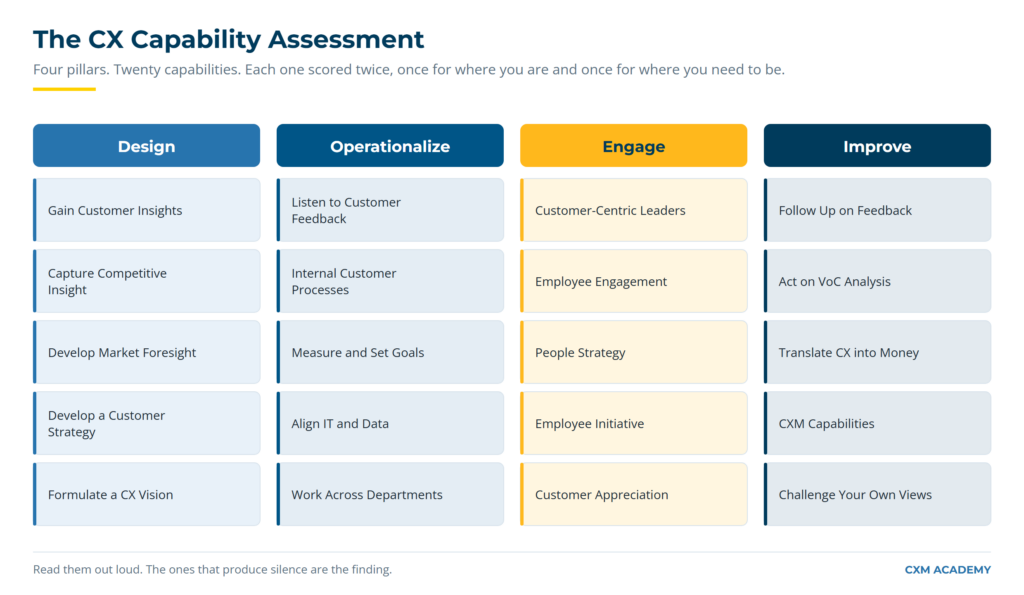
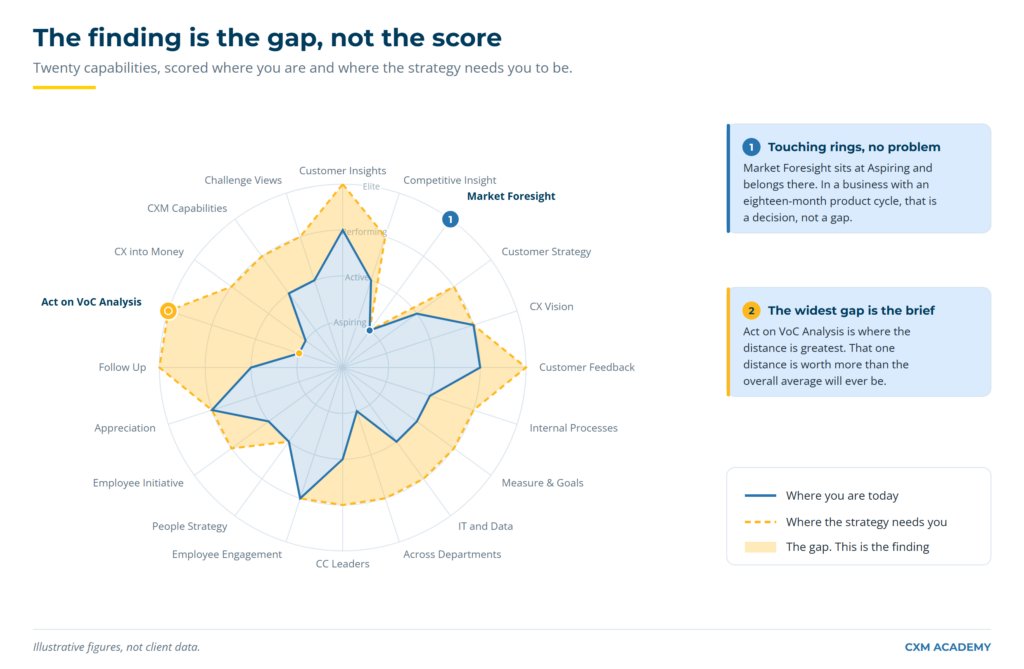
Each of the twenty is scored twice, once for where you are and once for where you need to be, on a ladder from Aspiring through Active and Performing to Elite. The output is a radar with two rings.
The second ring is the part people underestimate. A capability at Aspiring is not automatically a problem. Market Foresight at Aspiring in a business with an eighteen-month product cycle is a rational allocation of attention. The finding is never the score. The finding is the distance between the two rings, and which distances the organization has decided it can live with.
What an outside party adds is structural rather than analytical. Someone with no stake in the answer asks the questions, and the result carries a date that nobody can renegotiate in six months. Those are real advantages, and they are advantages of position, not of insight. Neither of them is a precondition for the model being useful to you this week.
The quarter you need an answer is rarely the quarter you have budget
That mismatch is structural. Assessments are commissioned on a funding cycle and questions arrive on an operational one, so the honest read is usually needed months before anyone could pay for one. Sometimes the organization has just come through a different assessment and has no appetite for another. Sometimes the question lands on the one person holding the whole function.
The twenty capability names work the same way in your hands as they do in ours. Reading them takes an afternoon, and the reading is the cheap part.
One capability, one decision, one quarter
Then comes the part that changes something, and it is narrower than it sounds. Not a program across twenty capabilities. One capability, one decision, one quarter, and the sequence matters because each step is what makes the next one possible.
Get the shortlist in an afternoon. Put the twenty names on one page and take them into a room that has marketing, service and operations in it, not only CX. Go through them slowly. You are not scoring. You are listening for which ones produce a confident answer, which ones produce a story about a project from two years ago, and which ones produce silence. The silences are the finding, and they arrive in about forty minutes.
Two things make that hour much sharper. Ask where each capability needs to be before you ask where it is, because the disagreement you get about the target is worth more than any score: it means the company has not yet decided what kind of CX organization it is trying to be. And scope the whole thing to one journey carrying real commercial pressure, since twenty questions about "the organization" invite abstraction and twenty about renewals invite evidence. Where the three functions agree you have a fact. Where they disagree you have the actual state of the organization, because a capability only one function believes in does not exist. That last point is the argument we made at length in The Journey-First Enterprise.
Choose the capability your next twelve months already needs. The obvious move is to take the lowest score. The trouble is that the lowest score is often something nothing in the plan requires this year, so building it wins you nothing anyone will notice. Look instead for the capability standing directly on a commitment the company has already made and funded: the market it just entered, the retention number in the plan, the platform it is migrating to. That capability arrives with a sponsor already attached, which is the hardest thing on this list to manufacture.
Name the decision it is supposed to change, and the person who makes it. This is the step that turns a capability into something a business can feel. Act on VoC Analysis is not a monthly review. It exists so that a roadmap, a policy or a price changes, and somebody specific makes each of those calls. If you cannot name the decision and the person, what you are about to build is a document that gets read. It is also worth knowing what happens when a practice loses its decision: it keeps running on schedule, with full attendance, for years, and stops producing anything at all.
Borrow a number somebody else is already accountable for. A CX number has to be defended every budget round. A number already sitting in a commercial or operations director's objectives defends itself, and it comes attached to a person who wants it to move. Churn in one segment. Cost to serve on one journey. Conversion on one step. Translate CX into Money gets considerably easier when the money already belongs to somebody.
Give it an owner who does not report into CX. This is the step that decides whether any of the rest survives, and it is the one most likely to feel like giving something away. It is the opposite. A capability owned by the CX team lasts exactly as long as that team's attention, and the CX team is usually the smallest one in the argument. The test is whether the practice survives the person running it, which is also the line between two of the levels on the ladder below.
Do that once and you are holding something no score can buy. A decision that changed. A number that moved. And a colleague outside CX who will say so out loud in a meeting you are not in, which does more for the next funding conversation than a maturity rating will.
The ladder, in the language people actually use
The four levels are easier to apply if you stop treating them as scores and start hearing them as sentences. Each level has a sentence that goes with it, and a structural test underneath the sentence:
| Level | What it sounds like in the room | The structural test |
|---|---|---|
| Aspiring | "We know we should be doing that." | Intent exists. No mechanism does. |
| Active | "We do that. Sarah runs it." | A mechanism exists and depends entirely on one person. |
| Performing | "That runs monthly. Here's the last output." | A mechanism with an owner, a cadence and an artifact. |
| Elite | "We changed how we do it last quarter, because the data told us to." | A mechanism that improves itself. |
The distinction that matters between Active and Performing is not frequency. It is whether the practice survives the person who runs it.
If you have already been assessed
Then you have a baseline, and baselines decay. The question is no longer where you scored but what has moved since, and four things are worth watching.
Watch the single-point-of-failure capabilities. Anything you scored Active is one resignation away from Aspiring. Re-check those by name, not by pillar average, because averages hide exactly this.
Re-ask "Translate CX into Money" every budget season. It is the capability most likely to be scored generously and the one most likely to be tested in public. If the answer this year is the same slide as last year, the capability has not held.
Track whether the to-be moved, not just the as-is. Strategy changes. If the company entered a new market or a new segment and nobody revisited the target ring, the gap analysis is now measuring against a plan that no longer exists.
Watch for what the model doesn't have a box for. No maturity model is a complete description of a domain. The design-science literature on building them is blunt that they are simplifications, and that the discipline is in documenting how they were built instead of pretending they are exhaustive.[2] If something keeps mattering in your organization and does not map onto any of the twenty, write it down. That is a finding about your business, not a flaw in your reading.
Scoring more often than you can act
There is one cadence mistake worth naming, because the model invites it.
Score everything, then score everything again a quarter later, and nothing has moved. Not because the work was not done, but because capability moves on the timescale of hiring, restructuring and system replacement, and a quarter is shorter than any of those. Measuring faster than the thing can change produces noise and no new information, which is an expensive way to spend the attention you will want later when you do have something to show.
The second point is about method, and it applies to us reading our own operation as much as to you reading yours. Any single-source read of a system this size drifts toward the view of whoever is doing the reading, and the research on self-assessment is consistent that this is hardest to avoid where the task is complex.[3] That is not an argument against the exercise. It is the argument for putting three functions in the room in the first place, working from evidence instead of impressions, and treating the first read as a hypothesis and not yet a finding.
The peer-reviewed CX maturity work is candid about the same limit from the other direction: models of this kind are built largely from expert judgment, and their authors are the first to say that qualitative construction needs validity and reliability work behind it before anyone treats a score as a measurement.[4] Use the number to start an argument. Don't use it to end one.
A workable rhythm: read the model quarterly, score it annually, and only score it when you can name the decision the score will inform.
When it is worth commissioning the formal version
Three situations, in our experience, actually justify it.
Leadership disagrees about where the company stands. An internal read cannot settle a disagreement between executives, because everyone in the room has a stake in the answer. An external one can.
Something structural is about to change. A merger, a new market, a re-platforming, a new operating model. A documented pre-change baseline is worth a great deal eighteen months later, and it is impossible to reconstruct after the fact.
You are asking for serious money. Not because an internal read is weaker work, but because a case is harder to argue with when the read behind it was not produced by the team asking for the budget. That is a fact about how funding decisions get scrutinized, and it has nothing to do with the quality of your own analysis.
Outside those three, keep reading the model yourself and spend the money on the gap it exposes. We would rather you close a capability than measure one.
Where to start this week
Put the twenty capability names in front of three functions rather than one, and note the silences. Then pick the capability standing on a commitment your company has already made, name the decision it ought to be changing and the person who makes it, and find it an owner who does not report into CX. One capability, one decision, one quarter. Then go back for the next one.
If it turns out to be Act on VoC Analysis, as it is for most organizations we work with, we have written about why that particular capability stalls and what moves it in From Mirror to Motor. The full model, and the practice of running it properly, sits inside CXM Professional.
The assessment is how you find out where you stand. The model is how you stop standing still.
Footnotes
[1] Homburg, C., Jozić, D., & Kuehnl, C. (2017). Customer experience management: toward implementing an evolving marketing concept. Journal of the Academy of Marketing Science, 45(3), 377-401. https://doi.org/10.1007/s11747-015-0460-7
[2] Becker, J., Knackstedt, R., & Pöppelbuß, J. (2009). Developing Maturity Models for IT Management: A Procedure Model and its Application. Business & Information Systems Engineering, 1(3), 213-222. https://doi.org/10.1007/s12599-009-0044-5
[3] Dunning, D., Heath, C., & Suls, J. M. (2004). Flawed Self-Assessment: Implications for Health, Education, and the Workplace. Psychological Science in the Public Interest, 5(3), 69-106. https://doi.org/10.1111/j.1529-1006.2004.00018.x
[4] Gallardo García, F. J., Pagán Castaño, E., Sánchez García, J., & Guijarro García, M. (2024). Creation of a maturity model to measure customer experience management by organizations. ESIC Market, 55(1), e343. https://doi.org/10.7200/esicm.55.343