
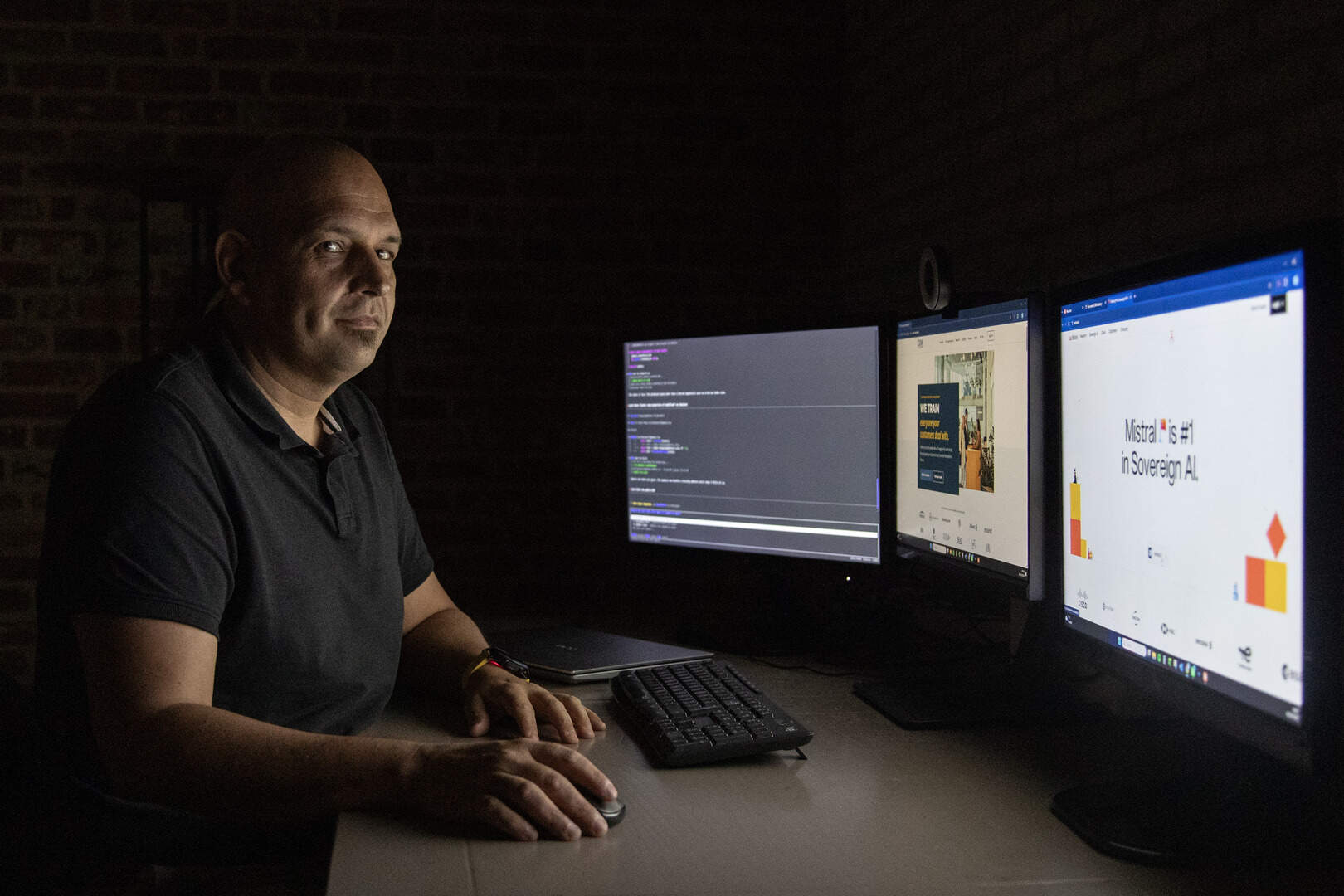
De Standaard, one of Belgium's leading newspapers, recently ran a piece on businesses that are trading American tech for European alternatives, and our founder Michel Stevens was one of the people they spoke to. It is a subject that keeps coming up in our conversations with clients, learners and partners, so we asked Michel to take it further for our own readers.
From ChatGPT to Anthropic to Europe
De Standaard wrote that until recently you leaned entirely on ChatGPT and Gemini. Is that the full story?
Not entirely, and not untrue either. In the very beginning we experimented with ChatGPT and with Google's models, like everybody did. But fairly soon we moved to Anthropic, because there was an ethical question playing in the back of our heads already. Failing fast and failing forward felt too much like part of OpenAI's DNA, and I was never a big fan of that. Gemini was decent but wasn't really up to speed in the beginning. Then Anthropic came along, and they're doing an incredible job.
So the honest sequence is this: we went where the best tool was, and we cared about who built it. That same logic is what eventually brought us to Europe. But that goes for all technology these days, not just AI.
You had been talking about European alternatives for a long time. Why the long wait?
Honestly, I wasn't so much waiting as waiting for something to exist. A real European alternative had to emerge first. Again, if we take the example of AI, then for a long time Mistral was behind the leading models, and you can't ask a business to run on the second-best tool out of principle.
The other half of the answer is that until recently there was no pressing need. Without going too deep into politics: the world has changed, and we have to rethink where our data lives and where our technology comes from, because that creates dependencies. We Europeans saw it very concretely in June, when a US export-control order forced Anthropic to switch off its most capable models, Fable 5 and Mythos 5. They came back a few weeks later. But for a few weeks, the best tool on the market simply wasn't there.
And that goes far beyond AI. Think about where your email runs, where your files are stored, how your payments are processed, which platform your customers log into. A European business runs almost entirely on technology that gets decided somewhere else. Most days that's fine. The day it isn't, there's very little you can do about it.
So we had two things at once. We depend more and more on technology, and we're in a period of real instability. Put that next to Europe finally having credible options, Mistral in France, Aleph Alpha's new Kolibri model in Germany, the Poro models that came out of Finland, TildeOpen from Latvia, EuroLLM from a European research consortium, and the conclusion was that now is the time to act.
Michael Jackson put it best in "Man in the Mirror": if you want to change the world, you start with yourself. We have the technology, we have the capability, and we have the drive. So we started with ourselves.
The CX lesson hiding in the switch
You told De Standaard that people stick with familiar tools out of convenience and muscle memory. That sounds like something you'd say about customers.
It's one hundred percent true, and there's a lot of science behind it. Economists call it status quo bias: people stick with the option they already have far more often than its merits justify, simply because it's the one they have. Habit research goes a step further. Once you've repeated something often enough in the same context, the context triggers it and your goals barely get consulted anymore. You open the same app every morning because that's where your hand goes. That was me, for years, with tools I had strong opinions about.
It's also why we build our trainings the way we do. Training is exposure, and adoption is something else. A course that gives people the right information and then sends them back into the same organization, the same meetings, the same reflexes, changes very little. So before we design anything, we ask why a behavior is stuck. Do people lack the skills, the opportunity, or the motivation? Very often it's the opportunity, and that means the environment has to change along with the people.
Customers work exactly the same way. A lot of what companies report as loyalty is that same habit, seen from the other side of the counter.
How does a CX team tell the difference?
Loyalty research has had an answer for about thirty years. Real loyalty needs two things at the same time: the customer keeps coming back, and the customer actually prefers you over the alternatives. Customers who come back without that preference look exactly like loyal ones in your retention figures. Researchers call it spurious loyalty, which I think is a wonderful name.
The test is simple and a little uncomfortable. Watch what happens when a barrier drops: a contract ends, a price goes up, a competitor offers to handle the move for them. Loyal customers stay. The others leave, usually without warning, because there was never anything to warn you about.
Europe's problem is the experience around the product
You also said Europe builds fantastic technology and is bad at selling it. What do you mean?
Two things. First, we have a lot of crazy good technology in Europe and we barely know it exists. reMarkable, the paper tablets, is Norwegian. So is Kahoot!. itsme, the digital ID half of Belgium uses, is Belgian. N26 is a German bank, and DeepL is German too. In robotics, NEURA Robotics in Germany, 1X, which started out in Norway, and Clone Robotics, founded in Wrocław, are building some of the most interesting machines around.
Whenever I tell someone reMarkable is Norwegian, they go "I didn't know that." If it were an American company, believe me, everyone would know. We're just not that chauvinistic about our own stuff. Tooting our own horn is not in our culture, and that makes it harder for us.
Second, we often sell on a very functional level. Go to Mistral's homepage and try to talk to their model. It's not impossible, but there's no chat box on the page; you have to find the right link first. Go to OpenAI or Claude, and the question box is the first thing you see.
Put those two together and you have a real problem. I remember a report for the European Commission on European competitiveness making the same point at the scale of a continent: Europe is strong at research and invention and much weaker at turning them into companies that scale. I'm a customer experience person, so to me a lot of that gap is the experience around the product. The product only gets judged once the customer has made it through the journey to it.
What still runs outside Europe
You haven't gone fully European.
That's true. Some pieces still run outside Europe, mostly hardcore infrastructure and some of the security measures we've built around it. Our payment system isn't European either; we work with Stripe. Those are things I'd love to bring to Europe once the opportunity is there.
Right now, though, our hands are full, in the best possible way. In the past few weeks alone we've run classrooms in Oslo, Antwerp and Riyadh. New clients are onboarding, new learners are joining our programs all the time, and we deliver in six languages. Behind the scenes the team is building new course material and working hard on the back end to keep up with all of that.
So it comes down to capacity and priorities. We don't have twenty people running around building things, so we choose, and client work comes first. That's the sad but true reality, and honestly, it's a good problem to have.
So what's the rule you work by?
Whenever we consider a new piece of technology, we look at what's leading edge today. Very often that's European, or there's a European equivalent. If there is, that's what we go for. Period.
It isn't chauvinism. The first reason is stability: we want to keep using a technology for years without wondering whether it will still be there next month.
The second reason matters even more to me. Joan Sardà, the customer and brand strategist, has a line I've borrowed many times: in Europe, we put the person first and the wallet second. You see it in how Europe regulates technology. Data protection, privacy and the rights of the individual come first, and business models have to fit around them. For a customer experience company that value is very concrete. Our clients trust us with their employees' honest answers and their customers' own words. Choosing technology that is built on the same principle is the most consistent thing we can do.
What clients will notice
What does any of this change for clients and learners?
Absolutely nothing. That's the one rule above all the other rules: our clients and learners can't see any difference between technology stacks. None. The only thing they experience is what they don't experience. More security, more stability, always up. That's what good infrastructure feels like from the outside: nothing at all.
Start with yourself
Last question. What should a CX leader do with this?
Most CX leaders don't own the tech stack, so I won't tell anyone to migrate their CRM because of an interview. What I would do is take a moment to reflect, and ask what the risks actually are. What does it mean for compliance when a tool you depend on changes its rules overnight? What does it mean for security? And what does it mean ethically, for the customers whose lives sit in those systems?
Then go and talk to your IT director. Chances are she's already thinking about this. If she isn't, raise the concerns you have, and the ones your customers might have in the future. This topic hasn't reached its zenith yet, and you want to be in that conversation before your customers start it for you.
And keep experimenting. We still have a Claude subscription, a Google one, and five or six other AI services we test all the time, because choosing European first doesn't mean you stop looking. Start with yourself. That's where it always starts.
Read the original article in De Standaard (in Dutch): ChatGPT? Deze bedrijven werken liever met Europese AI.