


The request usually arrives fully formed. We are launching the new onboarding flow in November. Can you run some research to validate it?
Read that again. The decision is made, the date is set, and the word doing the work is validate. What has been commissioned is a signature, not a study.
You can run it. You will come back with a yes, because studies commissioned to produce a yes reliably produce one, and the yes will be technically accurate and operationally useless. Nobody will do anything differently on Monday. Six months later the flow will underperform, and somebody will ask with genuine puzzlement why the research did not catch it.
The research did not catch it because nobody asked it to look. A study can only find what its question permits.
A binary question can only return one bit
Start with the information theory, because it is unusually clear here.
A yes-or-no question has two possible answers. Whichever one comes back, you have learned one bit. You now know which of two doors the room was already standing in front of, and nothing about the room.
Compare that with what the same study could have returned. Which customers struggled and at which step. What they were trying to accomplish when they gave up. Which of three plausible explanations for the drop-off survives contact with actual behavior. What would have to be true for this design to fail. Every one of those is actionable in a way that yes is not, and every one of them was available for the same fieldwork budget.
The binary framing did not make the study cheaper. It made it smaller.
The bias here is not a character flaw
It is tempting to read the validate request as intellectual cowardice, and that reading is both unkind and wrong.
Seeking and interpreting evidence in ways that favor a belief you already hold is one of the most thoroughly documented tendencies in psychology, present across expertise levels, professions and stakes, and it operates without any awareness of doing it.[1] The executive asking you to validate the November launch is not being dishonest. They have a hypothesis, they are looking for evidence consistent with it, and that is what human beings do by default.
This matters practically. If you treat the request as a moral failing, you will push back in a way that sounds like an accusation and you will lose. If you treat it as a predictable feature of how people reason under commitment, you can design around it, which is the rest of this piece.
Even a truthful yes may not survive contact with Tuesday
There is a second problem, and it survives even when the research is honestly commissioned and honestly answered.
People do not reliably do the things they say they will do. The gap between stated intention and subsequent behavior is well documented and it is large, large enough that intention explains only part of the variance in what people actually go on to do.[2] A customer who tells you the new flow looks clear is reporting a genuine belief about a hypothetical. Tuesday, on a phone, in a hurry, with a screaming toddler, is a different instrument entirely.
So the yes you collected has two independent weaknesses. It was solicited in a way that made it likely, and even if it was freely given it predicts behavior imperfectly. Building a launch on it is building on an opinion about an opinion.
This is the satisfaction score in another costume
CX teams recognize this failure immediately in someone else's research and then run it every quarter in their own measurement.
A satisfaction score is a yes-or-no question with decimal places. An 8 out of 10 tells you that the last interaction went acceptably for a person willing to answer a survey. It does not tell you whether they will choose you again, what they would have wanted instead, or which part of the experience earned the 8 and which part quietly cost you the 2.
We have written before about why customers do not remember their experience the way measurement assumes they do. The same limitation applies to any single-number verdict.
The constructive version is to stop asking one instrument to do three jobs. Descriptive measures tell you what happened. Perception measures tell you how it landed. Outcome measures tell you what the customer did next. A CX function that reports all three can locate a problem. A CX function that reports one number can only report a mood.
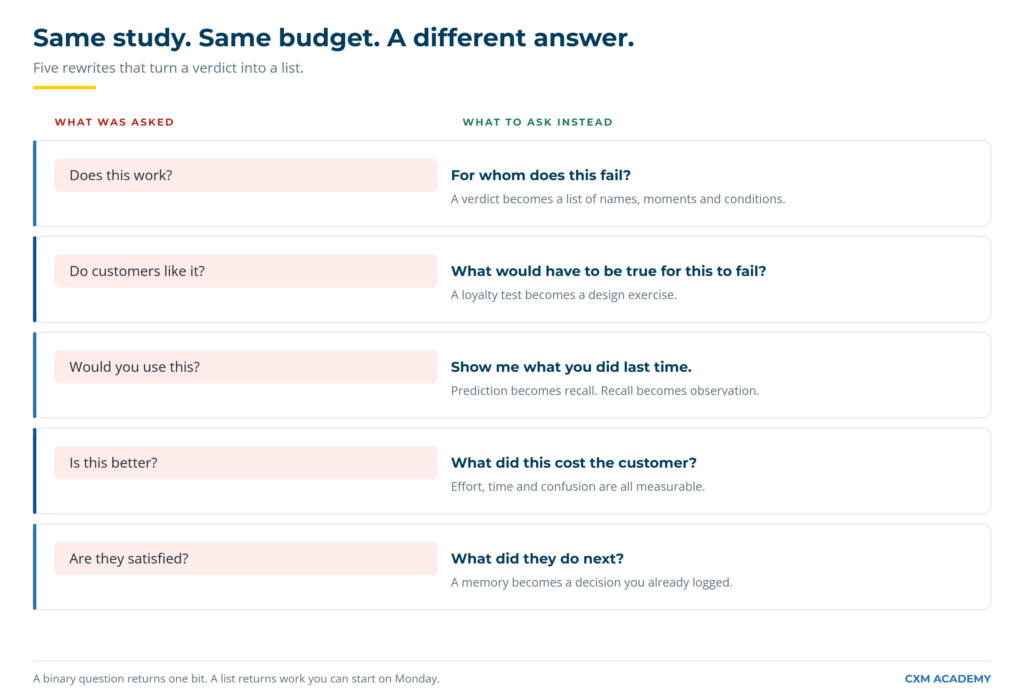
Five rewrites that change the answer
None of these require refusing the request. Each one takes the same study and returns something a team can act on.
Replace "does this work" with "for whom does this fail." Both are answerable with the same participants. Only the second produces a list of names, moments and conditions, and a list is a thing you can fix.
Replace "do customers like it" with "what would have to be true for this to fail." This is the single most useful reframing available to a CX researcher, because it converts a loyalty test into a design exercise and gives the stakeholder a role that is not defending their decision.
Replace "would you use this" with "show me what you did last time." Recall of past behavior beats prediction of future behavior, and observation beats both. The intention gap is the reason.
Replace "is this better" with "what did this cost the customer." Effort, time, attention and confusion are all measurable, and all of them survive the fact that people are poor judges of their own future actions.
Replace "are they satisfied" with "what did they do next." Satisfaction is a report on a memory. Behavior is a record of a decision, and your organization already logs it. The renewal, the second purchase, the second complaint, the quiet stop: those are all available without asking anybody anything, and none of them can be flattered by a well-phrased question.
A worked rewrite
Here is what the change looks like on a real brief, because the principle is easy to agree with and harder to apply under deadline.
The request as it arrived. "We are moving to a single sign-in across the three product lines in November. Can you validate with customers that the migration messaging is clear?"
What that study would have produced. Twelve participants shown three emails, asked whether the messaging is clear, ten saying yes and two saying mostly. A slide reading "messaging validated, 83 percent clarity." A launch. And in December, a contact center absorbing calls from customers who understood every word of the email and still had no idea what would happen to their saved payment methods.
The same fieldwork, reframed. "Show me what you would do next after receiving this. What are you now unsure about? Which of your three accounts do you think this affects?"
Same twelve participants, same two weeks, same cost. The output is a ranked list of the specific uncertainties the messaging creates, most of which have nothing to do with clarity of language and everything to do with questions the email never anticipated. That list can be fixed before November. A clarity percentage cannot.
Notice what did not happen in the reframe. Nobody challenged the migration. Nobody questioned the date. The decision the stakeholder had already made stayed made, which is exactly why the reframe is accepted rather than resisted.
When validation is genuinely the right call
An honest article has to include the case against its own argument, and here it is: sometimes validation is the correct instrument.
If a genuine go or no-go decision is still open, if a regulator requires evidence that a disclosure is comprehensible, or if two teams are deadlocked and need a tiebreak they have both agreed in advance to accept, then a binary study is the right tool and the reframes above would be an evasion.
The test is simple. Ask what happens if the answer comes back no. If there is a real, funded, named alternative course of action, validation is legitimate and you should run it cleanly. If the answer is that the launch proceeds anyway on a revised timeline, the decision is not open, and what the organization actually needs is the list.
Asking that one question out loud, in the room, is also the most graceful way to open the conversation. It sounds like diligence, because it is.
When the yes-or-no question is genuinely non-negotiable
Sometimes the request cannot be reframed. The board has asked, the deadline is real, and your job today is to answer the question as posed.
Answer it. Then add one paragraph.
Give the yes or the no in the first line, plainly, with no hedging, because hedging is what teaches stakeholders that researchers cannot give straight answers. Then add the conditions: the yes holds for this segment, on this device, for customers who have done this before. And then name the one thing you saw that nobody asked about.
That last sentence is where the value of the whole study usually sits. It is also the part that gets cut when a researcher tries to lead with nuance, which is why it goes at the end, after the answer the room came for.
Where to start this week
Take the next research request that arrives with a decision already inside it. Do not challenge the decision.
Write down the question as asked. Underneath it, write the same question rephrased to produce a list instead of a verdict. Take both to the person who asked, and let them choose. In our experience they choose the second one roughly every time, because nobody actually wants a verdict. They want to stop being nervous, and a list of specific, fixable things is far more reassuring than a yes.
If the answer keeps coming back as a number nobody can act on, the problem sits upstream in how the function turns evidence into decisions, which is the subject of From Mirror to Motor. The measurement discipline behind all of this is CXM Professional.
One more thing worth saying to anyone who has run studies like this and felt the result was hollow. The hollowness was real and it was not your fault. A study inherits the ambition of the question it was given, and a question built to close a conversation will close one, however well the fieldwork is executed.
A yes ends a conversation. Almost everything worth knowing was in the conversation.
Footnotes
[1] Nickerson, R. S. (1998). Confirmation Bias: A Ubiquitous Phenomenon in Many Guises. Review of General Psychology, 2(2), 175-220. https://doi.org/10.1037/1089-2680.2.2.175
[2] Sheeran, P., & Webb, T. L. (2016). The Intention-Behavior Gap. Social and Personality Psychology Compass, 10(9), 503-518. https://doi.org/10.1111/spc3.12265