Your CX capability is decaying
Capability does not send a leaving email. It goes when the analyst who ran the monthly voice-of-customer review moves to another team, and for a while nobody notices, because the review is still in the calendar. It goes when a reorganization puts service under operations and the weekly session that used to open with a customer story starts opening with handle time. It goes when a platform migration breaks a feedback loop and the dashboard keeps rendering, on data that stopped arriving in March.
None of that appears anywhere. Your dashboard measures outcomes, and outcomes move last. By the time the score reacts, the capability behind it has been gone for two quarters and nobody can say which two. Every arrival in this business gets an announcement. Departures of this kind get nothing at all.
Nobody logs a capability leaving
Organizations are good at recording arrivals. A new platform gets a project. A new hire gets an announcement. A new program gets a launch email and a slide.
Departures are quieter, and capability departures are the quietest of all, because the thing that leaves is a practice. Something that used to happen every month, that somebody used to own, and that produced an output somebody else used to read.
Practices die without a funeral. The meeting stays in the calendar for another two quarters. The dashboard keeps loading. The template still sits in the shared drive. Everything that made the capability visible survives it, which is precisely why nobody notices when the capability itself has gone.
Why the dashboard structurally cannot see it
Look at what a CX dashboard actually contains. Satisfaction scores. Net promoter. Resolution times. Churn. Complaint volumes.
Every one of those is an outcome. They describe what happened to customers after your organization did or failed to do something. They are, by construction, downstream of the capability that produced them, and they move on the customer's timescale instead of yours.
So a capability can fail in March, and the survey it feeds will keep returning acceptable numbers through June, because the customers answering in June are describing an experience that was designed while the capability was still working. The dashboard is working correctly. Reporting results is what it was built for, and results are a lagging description of a capability you already had.
This is why the annual assessment feels so strange when it lands. Nothing on the dashboard changed, and yet the honest internal read says three capabilities slipped. Both are true. One of them is early.
Knowledge depreciates faster than anyone plans for
There is a body of research on this that CX writing almost never touches, and it is worth knowing about because it is unusually well suited to our problem.
Work on learning in service organizations found that knowledge acquired through doing the work does not simply accumulate. It depreciates, and in service settings it depreciates rapidly, quickly enough that recent experience explains far more about current productivity than the total volume of experience an organization has ever accumulated[1] A team that was good at something two years ago and has not done it since is not a team that is good at that thing.
A parallel line of work argues that forgetting is a real organizational process with its own dynamics, and that some of it is accidental, some of it is a failure to consolidate something recently learned, and some of it is entirely deliberate[2] The useful implication is that forgetting is an event in its own right, with causes you can name and in some cases prevent.
Put those together and the picture is uncomfortable. Capability is a level you hold against a constant downward pull, and the pull is strongest on the practices you perform least often. Which, in most CX functions, means precisely the strategic ones: market foresight, competitive insight, translating experience into money.
Three ways a capability actually leaves
It helps to name the mechanism, because each one has a different tell.
The person leaves
Somebody was the capability. They ran it, they knew why each step existed, and the documentation was always going to be written next quarter. When they go, the artifact remains and the judgment does not. This is the most common route and the fastest.
The ritual dies
Nobody left, but the meeting moved to a worse slot, then to every second month, then to when there is something to discuss. Attendance thins from the top down. The practice is technically alive and has stopped producing decisions.
The reason is forgotten
The hardest one. The practice continues, on schedule, with full attendance, and nobody in the room can any longer say what question it exists to answer. It has become a report that gets produced because it gets produced. This one can persist for years and it scores well on any checklist that asks whether the activity happens.
Read the average and you will miss all of it
Here is the trap that makes decay invisible even to organizations that do assess themselves.
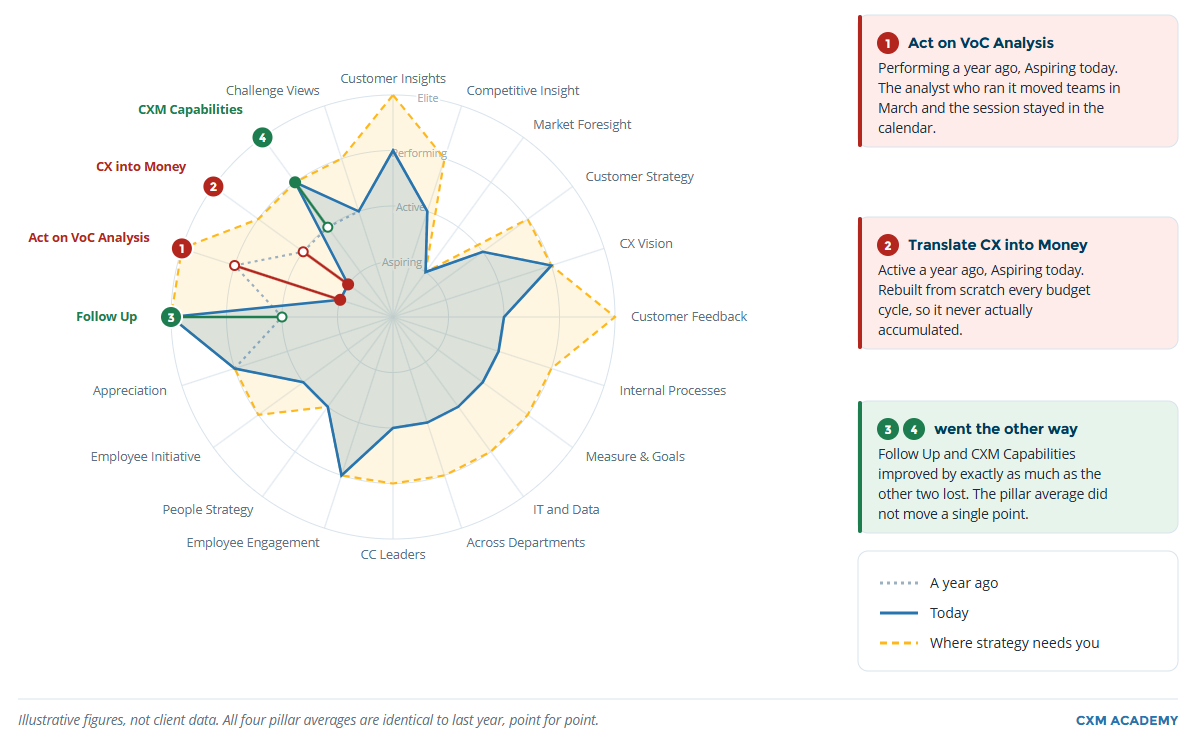
Pillar averages are stable. A capability that drops from Performing to Active while a neighbor rises from Active to Performing leaves the pillar exactly where it was. The summary number is honest and useless. The whole finding lives underneath it, in two capabilities that moved in opposite directions for entirely different reasons.
Compare capability by capability, by name, or do not bother comparing.
What the lag actually costs
Suppose the outcome does eventually move. Suppose churn ticks up two quarters after Act on VoC Analysis quietly stopped. You will find out in the end, and the finding will be expensive in four ways that nothing on your dashboard prices.
You have already shipped two quarters of a worse experience, to every customer who arrived in that window, and you cannot go back and run those months again.
The customers who left during those quarters are gone and unavailable for interview. Their reasons went with them. So the diagnosis you eventually run is assembled from the accounts of the people who stayed, who are by definition the ones the failure affected least.
A capability that has been absent for two quarters also costs more to restore than one that slipped last month. At some point restoration stops being maintenance and becomes a rebuild, with new people, fresh documentation, and a new argument for budget that somebody now has to win.
The fourth cost is political. A capability that decayed silently looks, at the moment of discovery, like somebody was not paying attention. That makes it tempting to find these things late and quietly, which is precisely the incentive that keeps the whole problem invisible for another year.
The five most likely to have moved since your last read
From what we see across assessments, decay concentrates. These are the ones worth checking first.
Act on VoC Analysis
The most common single-point-of-failure capability in the whole model. It usually depends on one analyst and one recurring session, which makes it vulnerable to both the first and second mechanisms at once.
Translate CX into Money
Decays every budget cycle, because it is rebuilt from scratch each time by whoever is preparing the submission. If this year's business case is last year's slide with the dates changed, the capability is gone and the artifact is covering for it.
Develop Market Foresight
Performed rarely, which by the depreciation argument makes it the most exposed of all. Also the easiest to claim credit for on the strength of one workshop eighteen months ago.
Work Across Departments
Depends entirely on relationships between named individuals. Survives a reorganization roughly as well as those relationships do.
Challenge Your Own Views
The one nobody audits, because there is no artifact. When was the last time a CX team ran something that could have proved its own strategy wrong, and what happened to the finding?
A twenty-minute re-read
You do not need a new assessment to do this. You need the capability names and last year's scores.
Go down the list and, for each one, ask a single question: can I name the last time this actually happened, and who did it?
Not whether it is on a plan. Not whether it is somebody's responsibility. Whether it happened, recently, and who performed it. If you cannot answer both halves within about ten seconds, that capability has moved, whatever it says on the last report.
Then mark each capability with the mechanism, if it moved: person, ritual, or reason. The mechanism determines the fix, and the three fixes have nothing in common.
What to do when you find one gone
If the person left, do not try to rebuild the practice from the artifact. The artifact is the residue, not the recipe. Find who consumed the output and ask what decision it used to inform, then rebuild backwards from that decision.
If the ritual died, do not reinstate the meeting. Reinstate the decision the meeting existed to make, and put it somewhere that already has attention. A capability attached to a meeting that people want to attend anyway is considerably harder to kill.
If the reason was forgotten, stop the practice for one cycle. Nothing exposes a hollow ritual faster than its absence. If nobody notices, you have your answer and you have freed the time. If somebody does notice, they will tell you exactly what the capability was for, which is the documentation you were missing.
Take last year's assessment, or whatever internal read you have. Cover the pillar averages. Go capability by capability and ask the two-part question: when did this last happen, and who did it.
Then treat the ones you cannot answer as the real output of the exercise. Not a score, and not a plan. A short list of things this organization used to be able to do.
Footnotes
[1] Darr, E. D., Argote, L., & Epple, D. (1995). The Acquisition, Transfer, and Depreciation of Knowledge in Service Organizations: Productivity in Franchises. *Management Science*, 41(11), 1750-1762. https://doi.org/10.1287/mnsc.41.11.1750
[2] de Holan, P. M., & Phillips, N. (2004). Remembrance of Things Past? The Dynamics of Organizational Forgetting. *Management Science*, 50(11), 1603-1613. https://doi.org/10.1287/mnsc.1040.0273
[3] Homburg, C., Jozić, D., & Kuehnl, C. (2017). Customer experience management: toward implementing an evolving marketing concept. *Journal of the Academy of Marketing Science*, 45(3), 377-401. https://doi.org/10.1007/s11747-015-0460-7
Related courses